
Security, Geopolitics, and Governance Challenges in relation to Arctic Extractive Industries
Place: Nuuk, Greenland
Date:
16-22 October 2017
Deadline for applications: 30 June 2017
Notification
of participation decision: 1 August 2017
Course description
There is a pressing need for an improved, more nuanced and complex, geopolitical and
security understanding in the Arctic, that includes both state and non-state actors.
This need has been brought home time and time again, particularly most recently with
the speculation surrounding the actions and activities of Russia and China. What are
the prevailing agendas, and who has influence on these?
During the Cold
War, the Arctic was about a reified notion of security and geopolitics that was the
purview of high politics and national interests. Security was about the protection
of the state, through the use of military means. Geopolitics focused on the balances
of power between states as states appeared to jockey for the best position globally
in relation to their national interests. State interests and these narrow (classic)
assumptions about geopolitics still remain, but the playing field has drastically
changed. Non-state actors ranging from local communities to industries, to
non-governmental organizations, and further to regional and international
institutions, have demonstrated that they all have interests and roles to play in
the future of the Arctic. The concept of security has (rightfully) been challenged
by those who have been excluded, and now includes perspectives about the future that
challenge state and classic political posturing. International institutions like the
Arctic Council have been designed to include the voices of non-state actors, not
least indigenous peoples, sending a message that debates about Arctic Futures are
not exclusive to the state. Most recently, the rhetoric about the Arctic has been
captured by narrow security and geopolitical interpretations that look to Russia as
a new challenge, wishing a return to its role as a superpower. In reality this
posturing is complex, and extractive industries play a fascinating and central role
in the ways in which Arctic nations negotiate new spaces.
Papers/presentations will explore the relationships between state, industry and
community in Arctic regions. Presentations will look at the power dynamics behind
the development of extractive industries, both decision-making with regard to
relevant legal codes, but with a focus on who/what (state? Non-state actors like
Industry, non-governmental organizations? Communities and then who in communities?)
decides how law is formulated and why. Additionally papers can explore who/what is
determined as a legitimate actor in these processes, and what happens in the event
of competing values around either extractives (primarily economic benefits, both to
local communities but also to the state not least with regard to energy security but
also geopolitical positioning) or cultures that rely on a protected (rather than
exploited) environment? How do local actors influence these processes, or do they?
And if they do, who are the local actors that gain the power to participate in these
processes and why? Are they considered legitimate by all (particularly in local
communities) or not and why? How do local actors work with the state, and to what
degree are they either separate/independent from the state, or not? How are
political actors in the state-industry-community nexus influencing broader
governance strategies and law-making and geopolitics in the Arctic regions?
Location: Nuuk, Greenland
Organizer: UiT The Arctic
University of Norway jointly with University of Lapland
Course code:
TBA (UiT) / TUKO 1217
Coordinators: Gunhild Hoogensen Gjørv
and Florian Stammler
Any and all interested PhD and Masters students are
welcome to apply. Students in funding partner countries (Norway, Canada, USA,
Russia, China, Denmark, Finland) are eligible for funding – the number of funded
participants will be limited to the funding available. All applications will be
considered on the basis of three criteria
– quality of the application
– relevance of the application to the programme and course topic
– possible
previous participation (to complete the UArctic certificate program)
If
you want to apply, please provide the following to fstammle@ulapland.fi and
gunhild.hoogensen.gjorv@uit.no:
1. letter of motivation (why you want to
go there and how is this related to your work)
2. CV
3. abstract of
paper / chapter to be presented there, can be a draft article, a draft chapter, a
draft research plan.
4. short ouline of your PhD or M.A. topic (surely you
have that, just send it along)
5. scan of your passport, home address and
telephone, for those who need a visa
If you send us items 1-5 before the
deadline, your application will enter the selection pool for funded participation.
Kaikki uutiset
Kaikki uutiset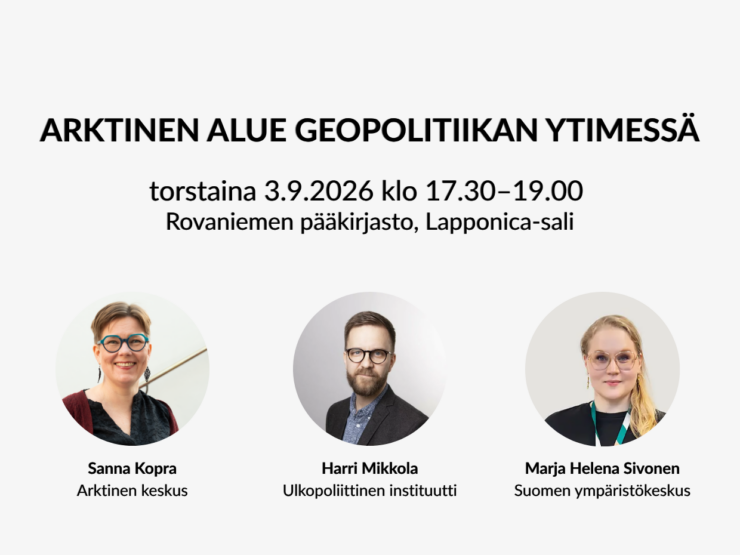
Arktinen geopolitiikka puhuttaa Rovaniemen pääkirjastolla
Arktinen alue on tällä hetkellä geopolitiikan ytimessä. Lapin yliopiston Arktisen keskuksen ja Ulkopoliittisen instituutin järjestämässä tilaisuudessa aihetta tarkastellaan…
Lappi ja Québec vaihtavat kokemuksia teollisesta murroksesta ja aluekehityksestä
Miten pohjoiset alueet voivat vastata teollisen murroksen ja vihreän siirtymän tuomiin muutoksiin? Lapin liitto ja Lapin yliopiston Arktinen…
Itämeripäivän tilaisuudessa voi kirjoittaa kirjeen Perämerelle
Kemin kulttuurikeskuksessa järjestetään Itämeripäivän kunniaksi tilaisuus, jossa on mahdollisuus nähdä päivän teemaan liittyviä filmejä, kuunnella meren ääniä ja…