

A new project focuses on everyday preparedness in Arctic borderlands
Arctic Centre’s Research Professor Florian Stammler and his team were granted funding to CULPRE project – Cultures of Everyday Preparedness in Sensitive Arctic Borderlands.
The CULPRE project investigates how culturally diverse borderland communities in Eastern Lapland and Eastern Finnmark prepare for and respond to crises. On this basis, the project shall develop a comprehensive theory in social anthropology and cultural studies of cultures of preparedness, explaining how different groups in society mobilize their traditional knowledge for preparing for crises – especially when living close to a high-tension border with a country at war.
Local, Indigenous, and immigrant populations have long practiced distinct cultures of everyday preparedness, as evident from concepts in their languages. These have been missing so far from studies and discourses on preparedness and everyday security. Such traditions — rooted in multi-species coexistence in challenging natural, cultural, social and political environments — have long equipped communities in the North with the skills to navigate crises autonomously.
CULPRE co-creates evidence on cultures of preparedness with traditionally marginalized groups in Arctic borderlands. Analyzing how preparedness is enacted in daily life across multi-ethnic contexts along the sensitive Arctic borderlands, CULPRE aims to harness the lived experience of crisis preparedness and people’s culturally diverse connected skillsets for enhancing community-based resilience and societal everyday security. Preparedness for crises has become increasingly important in public discourse in the last decade.
“Our scholarly and applied research results shall contribute to societal cohesion along NATO’s Arctic border with Russia”, says Florian Stammler.
The financing from Kone Foundation is 330 800 euros and the project will start in March 2026.
More information:
Research Professor Florian Stammler, Arctic Centre, University of Lapland
florian.stammler@ulapland.fi; +358 40 013 8807
More news
All news
Leena Leppänen has been awarded the title of Docent at the Arctic Centre
Leena Leppänen, Doctor of Philosophy, has been awarded the title of Docent at the Arctic Centre of the…
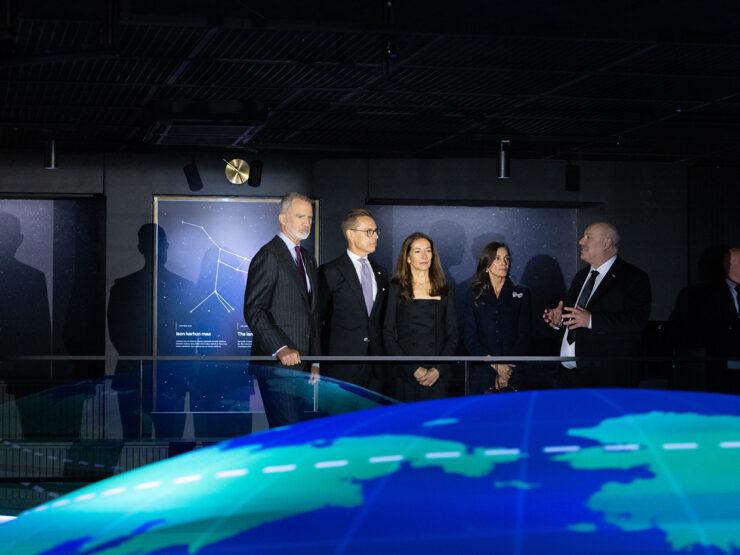
H.M. King of Spain and the President of the Republic of Finland with their spouses visited the University of Lapland and Arktikum
Their Majesties King Felipe VI and Queen Letizia of Spain and the President of the Republic of Finland…
A new publication examines the cumulative impacts of the green transition on traditional Sámi livelihoods
In Nordic cooperation made report "Towards understanding and managing cumulative impacts in Sápmi: approaches & collaboration – Workshop…