
Arctic Region
What and Where is the Arctic?
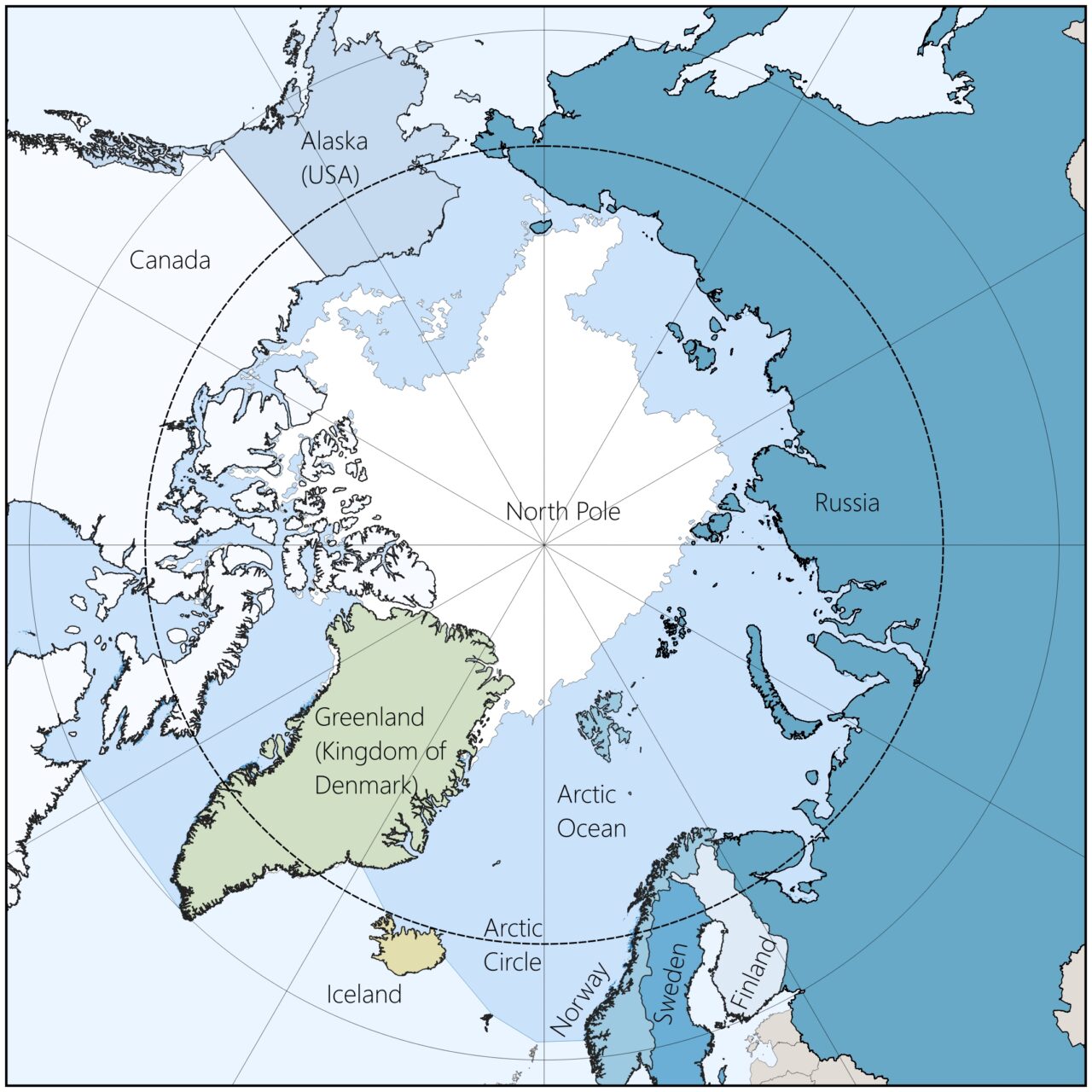
The Arctic region, or the Arctic, is a geographic region spreading around the North Pole. There is no single correct definition of the region as the southern boundary varies.
Indigenous Peoples | Biodiversity | Climate Change | Maps | Flowers | Birds
Key ways to define the Arctic:
- The Arctic Circle (66 ° 33’N) delimits the Arctic in terms of solar radiation. In theory, areas north of the Arctic Circle have at least one day without daylight in the winter and at least one nightless night in the summer. In practice, this does not happen everywhere because the surface of the earth is uneven, and the light refracts in the atmosphere.
- Based on temperature, the monthly average temperature in the Arctic is below + 10 ° C throughout the year, even in summer.
- The forest line follows a temperature-defined area. The forest line is not a narrow line but a zone tens of kilometres wide between the northern coniferous forest and the tundra. In this demarcation, the Arctic is predominantly wooded tundra and glaciers.
- Permafrost increases the area of Russian Arctic compared to the other delimitations. Permafrost is soil that stays frozen for at least two consecutive years.
- The ice cover determines the Arctic nature of marine areas. Sea ice is highest in February-March and lowest in September. The surface of the Arctic ice is monitored almost in real time by satellites. (see The National Snow and Ice Data Centre)
- Culturally defined, the Arctic covers the homelands of northern indigenous peoples.
- Political delimitations vary according to how they serve, for example, the interests of states or international cooperation.
As the climate warms, the Arctic shrinks if defined by temperature, forest line, permafrost, or ice cover. Cultural and political boundaries also vary. The Arctic Circle is the most permanent of the delimitations, although also the polar circle moves very slowly due to the variation of the Earth’s axial tilt.
Is Finland an Arctic Country?
Most of Lapland is in the Arctic, with the Arctic Circle as the southern border. Scientifically, Northern Finland is a subarctic region.
In its Arctic strategy, Finland defines itself as an Arctic country, but the boundary used by the Arctic Council is the southern border of the Arctic region, which is the provincial border of Lapland.
What is Life Like in the Arctic?
The Arctic is a vast and varied region, whose annual cycle is influenced by the strong variation in the amount of light. The further north you are, the more there are daylight hours in winter and nightless nights in summer. In the Arctic, winters are long, and the growing season is short. The Arctic land area comprises only about 5% of the land surface of Earth (Arctic Biodiversity Assessment 2013).
We often imagine the Arctic covered in snow and ice, but if we define the Arctic Circle as the southern boundary, the Arctic habitats range from snowy glades to green tundra and from lush forests to high mountains. The climate is strongly influenced by sea currents. Thanks to the Gulf Stream, the Nordic climate is milder than on similar latitudes, for example in Siberia.
Around 60% of the Arctic is sea, much of which is covered by year-round sea ice. The Arctic is also home to the largest island in the world, Greenland, most of which is covered by glaciers.
How Can Anyone or Anything Live in the North?
There are far fewer plant and animal species in the north than at lower latitudes. Still, the Arctic is home to more than 21,000 species: mammals, birds, fish, invertebrates, plants and fungi (Arctic Biodiversity Assessment 2013: Species Diversity in the Arctic).
Arctic animals and plants have adapted to cold and dark in many ways. The species of animals that live all year round in the north are characterised by a thick coat of fur or feather that keeps them warm in frost and wind. The animals store fat before winter and use the snow cover as a protection against the cold.
Adaptation to changing conditions is facilitated by factors related to the activities and characteristics of the animals, such as changes in colour and metabolism. Some animals hibernate during the winter to survive the long winter. Migratory birds, for their part, prefer the Arctic in the summer, when there is plenty of food and sunlight.
During the short growing season, the plants make effective use of the rays of the sun, for example, with their low structure and cup-like flowers. Wax or hair on stems, leaves and buds protect the plants from wind and cold.

Glacier Buttercup is the Northernmost blooming flower in East Greenland.
How Many People Live in the Arctic?
Four million people live in the Arctic, an estimated one-tenth of which are indigenous (Arctic Human Development Report 2015, see map with the definition of the region). The settlement is spread over eight states: Canada, the United States, Russia, Finland, Sweden, Norway, Iceland and Denmark. Greenland is an autonomous region of Denmark.
Most of the Arctic is sparsely populated. About two thirds of the population lives in urban and urban areas.
Extensive uninhabited wilderness areas are found especially in northern Canada and Russia and in Greenland. Greenland is covered by a continental glacier, which is why settlement is concentrated on the coasts. Even in the Arctic, people have settled permanently in areas that are freed from snow and ice in the summer.
The Arctic population grew rapidly in the 1950s and 1960s as health care developed, living standards increased and the use of northern resources increased. However, population growth has come to a halt and the population has even decreased, especially in northern Russia. (See the assessment on population development in the Arctic).

What Does the Word Arctic Mean?
The Arctic is named after the Greek word for bear. The bear is in Greek άρκτος, or kktos, which is also a word in the constellations of the Big Bear (in Greek Μεγάλη Άρκτος) and the Little Bear (in Greek Μικρή Άρκτος), which appear in the northern starry sky.

Black bear (Ursus americanus) wanders in Alaska.
Photo: Paula Kankaanpää.
What is the Difference Between the Arctic and the Antarctic?
The northern polar region of the Earth is called the Arctic and the southern polar region is known as the Antarctic.
- The Arctic has a sea in the middle (Arctic Ocean), but the Antarctic has a continent (Antarctica).
- Arctic lands are much more diverse in nature than the Antarctica. The Antarctica separated from other lands 23 million years ago and has been almost completely covered by ice for 15 million years.
- There are no land-based predators in Antarctica, which has allowed the flightless penguins to survive.
- When there is summer in the Arctic, there is winter in the Antarctica and vice versa. The polar areas are bathed in the sun during the summer, and in the winter, you will not see the sun at all.
- The Arctic has been inhabited for thousands of years and still has dozens of indigenous peoples. There are no permanent residents in Antarctica and there are no states.
- Northern Lights occur in both polar regions. In the north, they are called Aurora Borealis and in the south, they are called Aurora Australis.

Arctic sea ice. Photo: Ari Laakso