
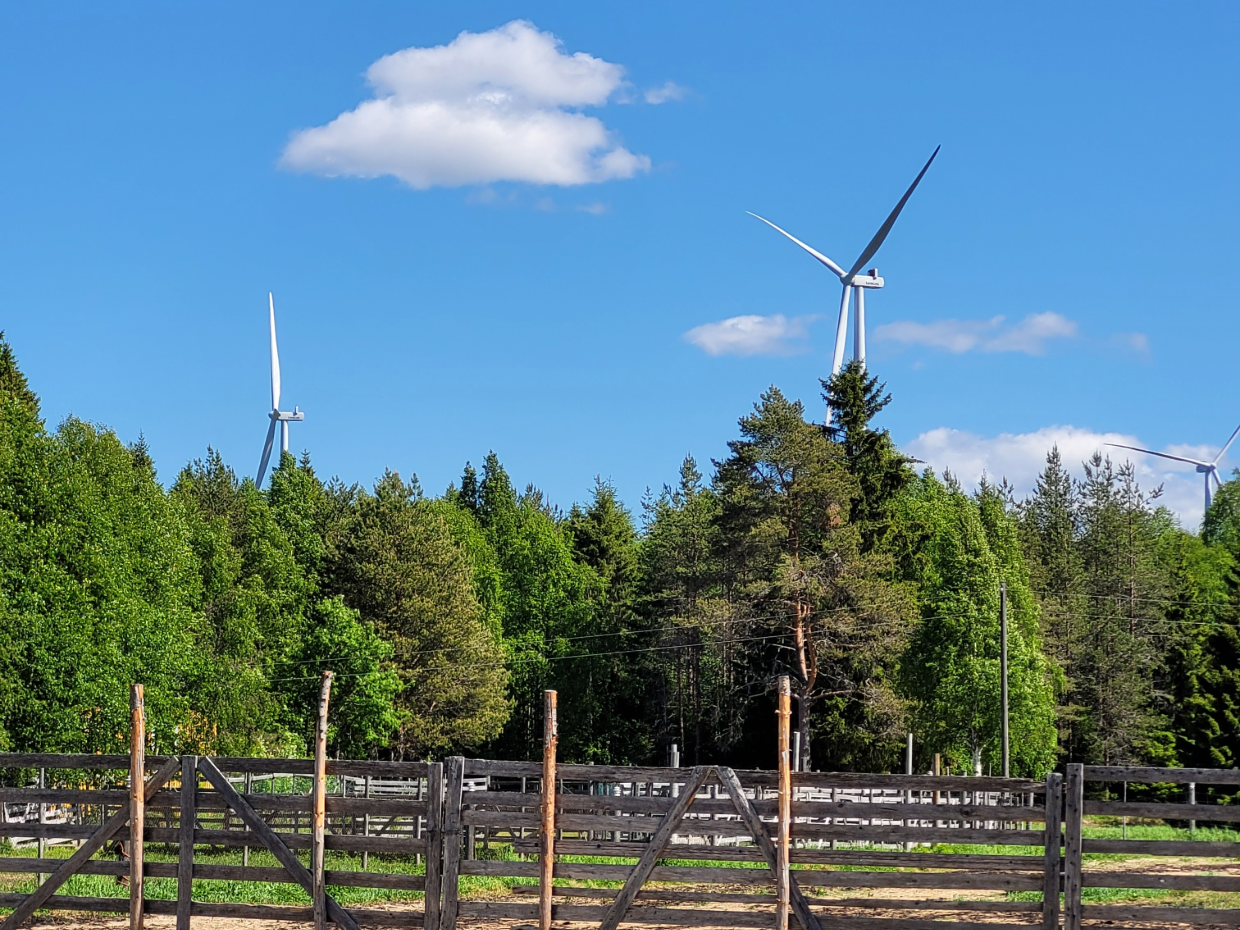
A new publication examines the cumulative impacts of the green transition on traditional Sámi livelihoods
In Nordic cooperation made report “Towards understanding and managing cumulative impacts in Sápmi: approaches & collaboration – Workshop Report with focus on spatial data, reindeer and reindeer herding” explores the use of spatial data and methods in assessing cumulative impacts on traditional Sámi livelihoods.
The impacts of the green transition on Sápmi and reindeer herding areas have been increasing due to factors such as forestry, rare-earth mineral mining, and the production of hydroelectric and wind power. The planning processes for these past, ongoing, and future projects are highly fragmented; consequently, the cumulative impacts of the projects and the perspectives of local people have not been adequately considered during the planning stages. Assessing the impacts of both historical and new activities in Sápmi requires concepts, frameworks, and tools capable of addressing cumulative impacts across space, time, sectors, and borders, as well as a stronger knowledge base to support just decision-making.
Based on a workshop held in Oslo in 2025, a group of experts from Norway, Sweden, and Finland has produced a report which summarizes existing research and focuses—using Nordic examples—on the cumulative impacts of industrial land use (such as wind power, forestry, and mining) on reindeer herding and reindeer. In addition to presenting key concepts and tools, the publication outlines six practical methods for mapping and predicting cumulative impacts of industrial land use on Sámi livelihoods. As the report focuses on reindeer herding, the tools presented are useful also for the whole reindeer herding areas.
The review is part of the BAVIS project, which is funded by the Ministry for Foreign Affairs. The workshop and the resulting review also received funding from the Nordic Joint Committee for Agricultural and Food Research (NKJ), a collaborative body funded by the Nordic Council of Ministers. The Sámi Parliament granted free, prior, and informed consent for the project in November 2023.
Both workshop and workshop report were coordinated by Bernardo Brandão Niebuhr from the Norwegian Institute for Nature Research. The Arctic Centre at the University of Lapland took part in the project with researcher Sirpa Rasmus.
Access to the whole report: Workshop Report
More information on the BAVIS project: Sustainable green transition in Barents region
More news
All news
Leena Leppänen has been awarded the title of Docent at the Arctic Centre
Leena Leppänen, Doctor of Philosophy, has been awarded the title of Docent at the Arctic Centre of the…
H.M. King of Spain and the President of the Republic of Finland with their spouses visited the University of Lapland and Arktikum
Their Majesties King Felipe VI and Queen Letizia of Spain and the President of the Republic of Finland…
A new project focuses on the viability of volunteer work in northern regions
The importance of volunteer action for societal preparedness and resilience is growing amid global polycrisis. Current global challenges…