

Dissertation: Social Licence to Operate of Mining at the Societal Level
In her doctoral dissertation, M.A. Pamela Lesser examines how the social licence to operate (SLO) of mining functions at the societal level. The research shows that societal SLO is actually not important for the local acceptance of a project and only has some influence in combination with local factors. The research corroborates that site level factors matter more to local communities and the public than do broader debates around societal benefits and costs.
The utility and power of the SLO concept continues to rest in
its ability to strongly encourage mining companies to prioritise community
interests.
– It is a powerful tool yet one that continues
to have difficulty gaining traction in Europe, Pamela Lesser
describes.
According to Lesser, it is
important to explore whether having the broader public acceptance of the mining
industry is the key to also having the acceptance of mining projects by local
communities. Lesser’s research shows this is not the case, and in so doing,
validates that SLO is a local concept with the most important relationship being
between a host community and mining company.
– SLO at the
societal scale is not important for the local acceptance of a mining project. What
matters for acceptance is the community-company relationship and the ability to
negotiate issues that happen at the site level. Societal acceptance plays a
supportive role to community acceptance and is dependent on it.
Lesser and her colleagues has developed a Scalar SLO Model, which integrates
within a single model the drivers of acceptance and loss at both the community and
societal scales. One important difference between the Scalar SLO Model and other
models is the incorporation of government as a foundational driver both at the
community and societal scales. Previously, government was theorised to have a role
in SLO, albeit undefined, only at scales beyond the community.
Lesser reconceptualizes the mechanism of SLO in a number of significant ways,
the most important of which is that it consists of preconditions and industry
drivers. At the societal level, the preconditions are comprised of government and
associated legal and regulatory frameworks, which must be fulfilled before the
industry drivers, meaning the relationship building between a community and company
or industry and society, can begin.
– The fulfilment of
both the preconditions and drivers should ideally lead to trust and acceptance. In
Europe, citizens who view the preconditions as being sufficient do not really expect
that much ‘extra’ from companies because the legislative and regulatory demands are
already quite high.
Results are useful for both
academics and practitioners
Globally SLO has been one of the
most important tools in the last 25 years to reconcile the competing tensions
surrounding mining. But not in Europe, in part, because there have been very few new
mining projects permitted for decades. With the energy transition and climate change
high on the European agenda, complemented by the recent adoption of the Battery
Regulation and the Critical Raw Materials Act, policy and legislation in Europe now
support domestic extraction, minerals processing and recycling.
– While mining on European soil is a high priority, it is also a conflicting
one for host communities, in particular.
The research
results are useful for both academics and practitioners. For academics, the
reconceptualisation of SLO offers opportunities to test whether the importance of
preconditions vary in different countries across Europe and also in different
regions of the world. For example, because of the importance of preconditions at the
societal level in Europe, there is little room for industry to manoeuvre around the
relationship-building work because there is little than can be negotiated. In
Europe, acceptance is largely defined as the fulfillment of the preconditions.
– For practitioners, to bolster the acceptability of
preconditions, different government-industry contracting models should be identified
and relevant ones tailored to Europe potentially implemented.
The research is based on a variety of data including fieldwork such as meeting
with public authorities, industry representatives, and civil society leaders, as
well as written material, such as mining sector good practice guidance and
sustainability reports and documentation from governments.
Information on the public examination
Pamela Lesser will be
defending her dissertation Scales of Trust. An Exploration of the Social
Licence to Operate of Mining at the Societal Level with the permission of
the Faculty of Social Sciences at the University of Lapland on Friday 24 January
2025 at 10 a.m. in lecture room B 126.
The opponent is
Associate professor Matti Kojo from Lappeenranta –
Lahti University of Technology and the custos is Associate professor
Janne Autto from the University of Lapland.
The public examination can be followed online at https://blogi.eoppimispalvelut.fi/ulapland/
The language of the public defence is English.
Information on the doctoral candidate
Pamela
Lesser holds a Master of Arts degree in urban planning from the University of
California, Los Angeles. She has been working for government, consultancies and
think tanks for 20 years and as a researcher at the Arctic Centre in the Arctic
Governance Research Group for 11 years. She recently became a senior expert with the
Research Development and Innovation Services unit at the Lapland University
Consortium. Concurrent with her work as a researcher, Pamela was the Regional Lead
at the Initiative for Responsible Mining Assurance (IRMA), a global mining standard,
in charge of raising awareness of IRMA within Brussels policy circles. Her research
interests focus on sustainable mining practices in the north, particularly, the
social licence to operate (SLO) concept and environmental impact assessment. Her
thesis topic draws on both her academic and practitioner experiences, mirroring the
development of the SLO concept as an iterative one continuously drawing on theory
and practice.
Further information
Pamela Lesser, +358 40 484 4051, pamela.lesser(at)ulapland.fi
Information on the publication
Pamela Lesser
(2024) Scales of Trust. An Exploration of the Social Licence to Operate of
Mining at the Societal Level. Acta electronica Universitatis Lapponiensis
396. ISBN 978-952-337-464-5, ISSN 1796-6310
The permanent
address of the publication: http://urn.fi/URN:ISBN:978-952-337-464-5
More news
All news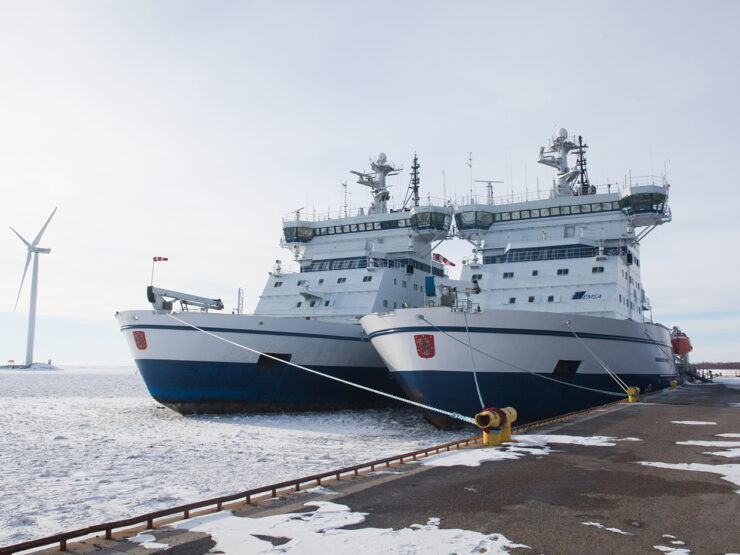
New project to examine the use of AI in shipping
AUTO-MARE project aims to develop framework for environmentally just, transparent, and accountable use of AI in shipping industry.
New funding to suport community-based green transition projects in the Arctic
The project aims at supporting fair, transparent, and locally accepted green transition projects in the Arctic region. The…
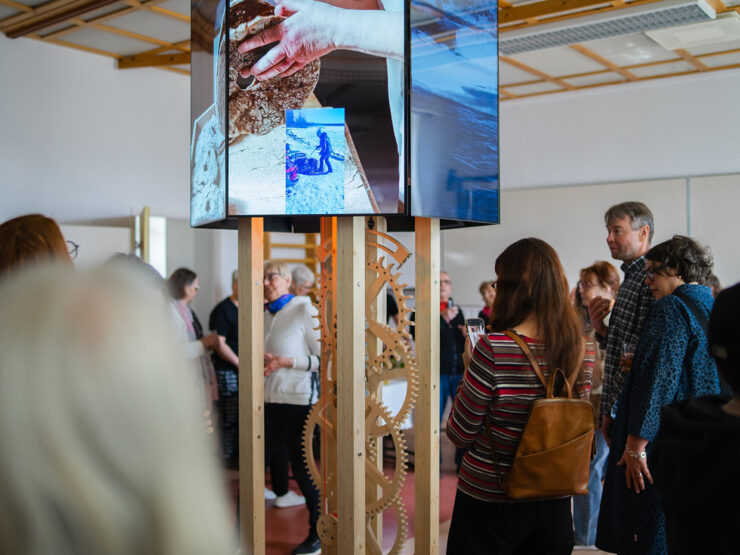
The World’s Most Valuable Clock preserves valuable moments of life
The World’s Most Valuable Clock is an artwork created as part of the Oulu2026 Climate Clock Project. Arctic…