
Ayonghe Akonwi Nebasifu, M.A., studies in his dissertation the unequal power relations between officials and local people in the co-management of the Mount Cameroon National Park and its adjacent communities. Ayonghe’s work contributes to co-management theory by revealing simultaneous compliance with and opposition to various relations of power in which people use official and unofficial strategies to attain their goals within a system of resource management.
Collaborative management (co-management) is applied
globally and often in the governance of protected areas such as national parks,
wilderness areas, marine environments, and other types of nature reserves. Its
procedures entail the sharing of power and responsibilities between local resource
users and state authorities, but this is never easy because of the diverse actors
and opinions involved. Thus, there is a need for novel ideas about how local
communities can navigate the difficulties of co-management.
Ayonghe conducted six years of ethnographic research in the Mount Cameroon
National Park in sub-Saharan Africa – an IUCN (International Union for Conservation
of Nature) category II protected area in the Gulf of Guinea Forests in West Africa.
He investigated the nature of power relations between the co-management regime of
the Mount Cameroon National Park and its local residents. Ayonghe was especially
interested in whether the local residents have the capacity to be resilient in times
of crises within the co-management system, and what kinds of relations exist between
local knowledge and biodiversity conservation within this system.
A twofold set of practices allowing cultural continuity
Ayonghe’s study draws on an overarching
theoretical framework informed by the connection between power, hierarchy, and
egalitarianism. It also unpacks the concepts of traditional knowledge, agency, and
cultural resilience embedded in this framework.
The results
suggest that even when co-management does not provide space for the proper
integration of local knowledge, people can preserve their culture and livelihoods
through acts of cultural resilience, agency, and the use of traditional knowledge.
– As agents, people can concurrently follow and circumvent the
official system to cope with changes in the local environment. For example, through
conservation development agreements (CDA), the park regime provides incentives to
boost agricultural activities among the locals in exchange for limiting their
utilisation of biodiversity in state-protected areas. While some individuals welcome
this approach for the income benefits it affords, others resist the system when it
hinders their freedom to exercise their customary rights on the land, Ayonghe says.
This being the case, people engage in a twofold set of practices
that allows cultural continuity in the context of co-management.
The potential of traditional knowledge in biodiversity
conservation
The study brings forth ideas as to
the best decisions to be made in order to preserve biodiversity without changing the
way in which indigenous groups have used their land for a long time.
– For instance, we can adopt good practices from the people’s spiritual
connection to giant tree species native to the Sahara that the people have preserved
for thousands of years before the introduction of state-prohibition laws over the
use of forests.
The existing systems of resource governance
should not take for granted the traditions and cultural relations that indigenous
groups share beneath the shadow of power differences within co-management and
related systems.
In Australia, North America, and the Canadian
Arctic, experimental procedures are implemented through the Indigenous Protected
Areas (IPA) model where indigenous groups decide how to best manage and promote
their forests.
– The same can be done in the Mount Cameroon
National park, since the people have experience spanning many generations as
custodians of their environment, Ayonghe notes.
Information on the public
examination
The academic dissertation
Knowledge Integration in Co-management: A Study on the People of the Mount
Cameroon National Park by Ayonghe Akonwi Nebasifu, M.A., will be publicly
examined in the Faculty of Social Science at the University of Lapland on Wednesday
2 March 2022 at 12 noon in lecture hall LS2 (Yliopistonkatu 8). The opponent is
Associate Research Professor (International forest policy and governance) Sabaheta
Ramcilovic-Suominen from LUKE (Natural Resources Institute Finland) and the custos
is Research Professor (Northern Anthropology) Florian Stammler from the Artic Centre
at the University of Lapland.
The public defence can be followed
online at https://blogi.eoppimispalvelut.fi/ulapland/
Coffee will be served in Restaurant Felli after the
session.
Information on the doctoral
candidate
Ayonghe Akonwi Nebasifu graduated in
2011 from the University of Buea as a Bachelor of Science (B.Sc.) in Sociology and
Cultural Anthropology with a minor in Journalism and Communication. In 2014, he
completed a master’s degree (M.A.) at the University of Lapland in Audiovisual Media
studies with a minor in Tourism Management.
Ayonghe has been a
member of the Anthropology Research Team at the Arctic Centre of the University of
Lapland since 2016. Earlier, he has worked as an assistant conservator at an animal
rehabilitation centre in Cameroon, as a researcher in the Cameroon Ministry of
Forestry and Wildlife, and as an intern in ERUDEF (Environment and Rural Development
Foundation), places where he gained an awareness of the challenges in forestry and
wildlife conservation.
Further information
Ayonghe Akonwi Nebasifu
phone: 040 484
4231
aayonghe(at)ulapland.fi
Information on the publication
Ayonghe Akonwi Nebasifu: Knowledge Integration in
Co-management: A Study on the People of the Mount Cameroon National Park. Acta
electronica Universitatis Lapponiensis 332. ISBN 978-952-337-307-5, ISSN 1796-6310.
University of Lapland, Rovaniemi 2022.
Permanent address of
the publication: http://urn.fi/URN:ISBN:978-952-337-307-5
More news
All news
New project to examine the use of AI in shipping
AUTO-MARE project aims to develop framework for environmentally just, transparent, and accountable use of AI in shipping industry.
New funding to suport community-based green transition projects in the Arctic
The project aims at supporting fair, transparent, and locally accepted green transition projects in the Arctic region. The…
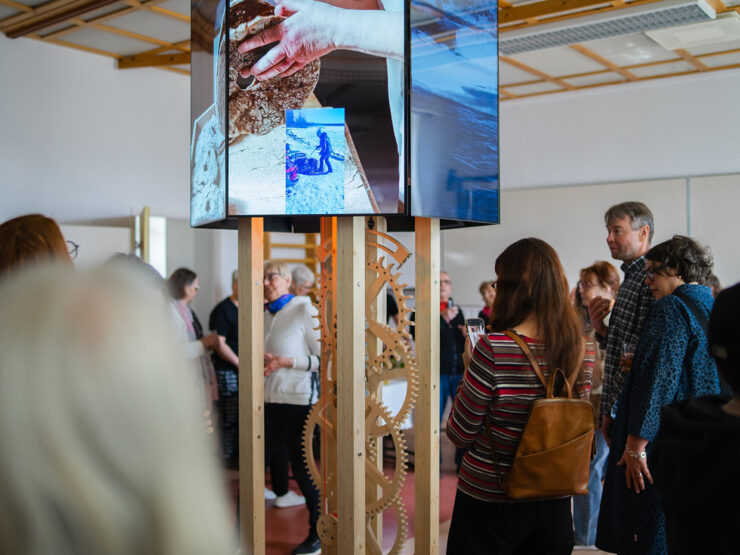
The World’s Most Valuable Clock preserves valuable moments of life
The World’s Most Valuable Clock is an artwork created as part of the Oulu2026 Climate Clock Project. Arctic…