
Nuccio Mazzullo left Sicily for Lapland to meet the opposite of his own culture, but ended up meeting his mirror image. An anthropologist specialising in Lapland and in Sámi reindeer herding wants to remind people that humans are a part of nature, and nature is a part of us.
Anthropologist Nuccio Mazzullo has never enjoyed
working in an office. Instead of air-conditioned office environments, he has
preferred fieldwork outdoors, in the nature. According to him, this is partly
hereditary.
– I was born and raised on the island of
Sicily, which has a long tradition in sustainable agriculture, and in fostering the
interaction between man and nature. Island life is about living outdoors, under
extreme conditions.
When Mazzullo arrived in Lapland for
the first time in 1990, he encountered different kind of extreme conditions. There
was snow on the ground, the Inari Lake was frozen and you could walk on it until
late in the spring. The man was over the moon. His thesis was the only thing missing
from his sociology degree, and he had the opportunity to travel to the dream
destination to learn more about the Sámi culture. There was something intriguingly
foreign, yet familiar about it.
– I came here to meet the
opposite of my own culture, but I came across my mirror image. Just as Sicilians are
culturally required to become Italian, the Sámi are required to become Finnish. In
Sicily, the temperature is +40 degrees Celsius and in Lapland -40 degrees Celsius.
Both are minority cultures fighting for their rights, Mazzullo compares.
Admittedly, there are plenty of congruent opposites. But how did a
Sicilian anthropologist hear about the Sámi and become interested them in the first
place? According to the man himself, the story is somewhat romantic.
– It all started in my childhood when my sister read me Sámi shaman
tales as bedtime stories. I still read them and they still inspire me. Later, when I
was studying anthropology, the Sámi emerged again. I feel that this field of
research was handed to me.
The job in Inari lasted for one
and a half years for my sociology degree. It was followed by two more years of
fieldwork for the doctorate degree in anthropology at the University of Manchester.
The time in England was rewarding, but he spent his days pining for Lapland. He
returned already the following year. That was no surprise to the man himself, nor to
his friends in Inari.
– I had had a premonition that I
would be coming back. I knew that I was at home in Lapland. Every time I was back, I
was able to write, do research and fieldwork. That meant travelling with reindeer
herds and learning Sámi crafts. For me, it is important to participate in order see
how things are done.
Photo:
Nuccio Mazzullo’s archives
Mazzullo, who
specializes in Finnish Lapland and in Sámi reindeer husbandry, has been working and
teaching at the Arctic Centre since 2007. Through his work, he wants to remind
people that man is a part of nature and nature is a part of us humans. They are not
two distinct elements, but one and the same.
Mazzullo
acknowledges that he has become estranged from his country during his 25 years of
absence, but admits that he is still “as Sicilian as a Sicilian can be”.
It means following the cycles of nature and observing the principles of
sustainability. For a researcher who loves outdoor life, office work is nowadays not
only an inevitable part, but also a great pleasure.
– The
Arctic Centre is a rich and versatile research environment. Here, we return to the
original state where researchers were philosophers and gathered together to share
their thoughts and experiences. This is what we do here at the Arctic Centre and I
am grateful to be a part of this scientific research community.
Nuccio Elio Mazzullo
- Research fellow, Anthropology Research Team
- Honorary Vice Consul of Italy
- His
research areas include the Finnish Lapland, Sámi reindeer husbandry, hunter-gatherer
cultures, interaction between man and nature, and the anthropology of circumpolar
regions. - Nuccio Mazzullo’s publications and projects can be
accesses through the LaCRIS research system and on the Arctic Centre website
Interview and main photo: Maria
Paldanius
More news
All news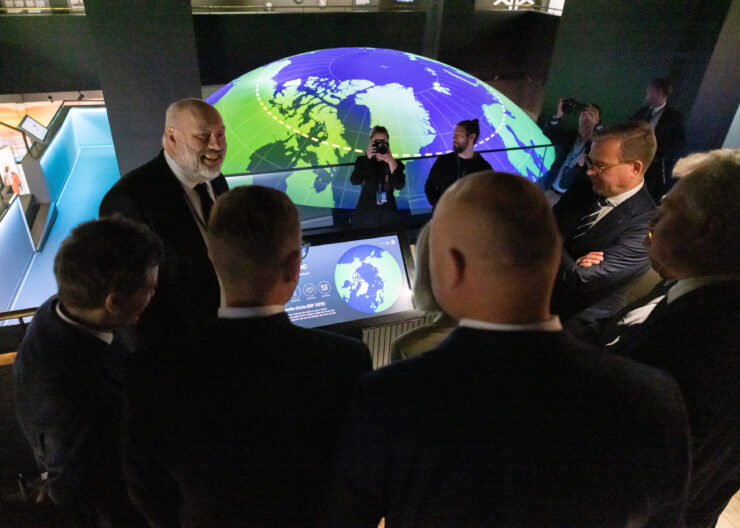
EU leaders visited Arktikum as a part of the European Arctic Summit held in Rovaniemi
The European Arctic Summit was held in Rovaniemi 13-14 September 2026, where EU leaders gathered to address issues…

Collaboration to find solutions for waste management in Arctic municipalities
Nadezhda Filimonova’s desire to use her research to bring tangible benefits to the residents of the Arctic led…

New EU-funded project Beyond Arctic PASSION officially launched on 1st September, runs for four years
Beyond Arctic PASSION works to build a more coordinated Arctic Observing System of Systems to address the challenges…