
We should all understand the importance of cyber security for our everyday life, says researcher Mirva Salminen who looks at digitalisation and cyber security in the Arctic.
When researcher Mirva Salminen moved to Rovaniemi
about a year and a half ago, the number of places she had lived in during her life
went up to twenty. Salminen was accustomed to moving regularly, but Lapland was a
new and unfamiliar living environment that she had not found particularly
interesting other than as a hiking and skiing destination. As is typical of
researchers, Salminen’s interest in a subject, its characteristics and related
phenomena is most often generated through her own research.
– Before, Lapland was not one of my research priorities. Arctic issues have become
more important and more familiar after I moved to Rovaniemi and joined the research
team of the Arctic Centre. The international atmosphere of the city was also a
positive surprise.
There are five research groups working
at the Arctic Centre. Salminen is part of a three-year research
project in the Northern Institute for Environmental and Minority Law. The
project looks at digitalisation and cyber security in the northernmost areas of
Europe, especially from the points of view of the individual and the community. The
project is a cooperation of four organisations: UiT – the Arctic University of
Norway, Swansea University in the UK and the Institute for Security and Development
Policy in Sweden in addition to the Arctic Centre. Salminen’s role in the project is
connected to cyber security that she has worked on for a long time, both in the
public and the private sector.
– The Arctic Centre needed
someone who knew about cyber security, and that was how I ended up here. With the
project, she will also complete her doctoral dissertation.
The research project that was launched in early 2017 and will continue until the end
of 2019 is one of a kind. The digitalisation and the cyber security of the Arctic
regions are researched side by side, not as two separate phenomena. The latter
convention is the prevailing one, according to Salminen, and it can be problematic.
If things are kept separate, the discussion becomes fragmentary.
– Digitality is often seen as something positive, while with cybersecurity the
discussion easily takes a negative turn. In our research, we bring the opportunities
and challenges together and examine them in a comprehensive way. Everything affects
everything, and we should all understand the importance of cyber security for our
everyday life.
Last
autumn the University of Lapland organized Science Slam during the Science Days.
Mirva Salminen performed a rap on cyber security. Photo: Marko
Junttila
The three-year endeavour has now reached
midterm, and according to Salminen it is well on schedule. She gives credit for that
to the professional and international unit at the Arctic Centre, as well as to the
researchers in the collaborating organisations that share a common vision and
interest in the Arctic regions. Salminen herself has worked in Rovaniemi since
summer 2016. The work has included both lonely hours in the office on the third
floor of the Arktikum house and plenty of international cooperation.
– For one and half years I have been writing, reading and giving talks
which are all par for the course for a researcher, Salminen laughs.
Towards the end of the project, the research results will be made
available to everyone in the form of academic articles. In the meantime, the
researchers will speak in various national and international events. The next one
will take place towards the end of May, when an open conference Human Security and a
Cyber Multi-disciplinary Framework in the European High North will start at the
Arctic Centre on 24 May.
Mirva
Salminen
• Researcher, Northern Institute for Environmental and
Minority Law
• Master of Social Sciences (M.Sc.)
• Research
topics: cyber security, commercialisation of security, digitalisation in
Europe’s northern regions
• Motto: ”Curiosity makes the world
interesting.”
Additional information:
• Lacris profile
• Arctic Centre profile
• Human Security and a Cyber Multi-disciplinary Framework
in the European High North conference 24-25 August 2018
Text and photo: Maria Paldanius
More news
All news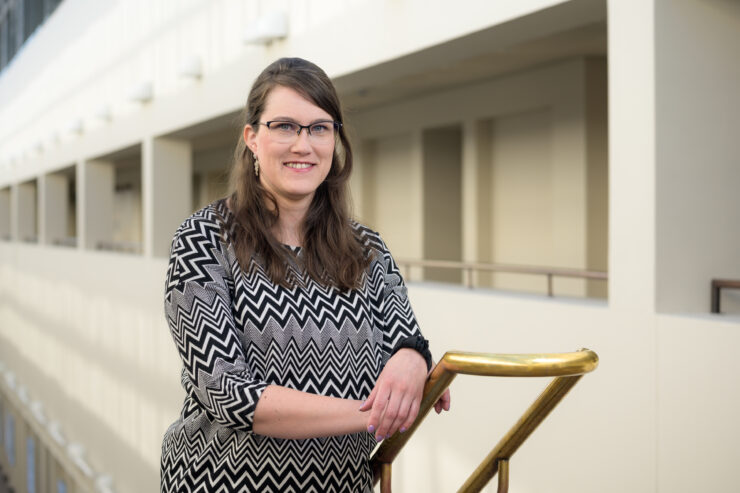
Leena Leppänen has been awarded the title of Docent at the Arctic Centre
Leena Leppänen, Doctor of Philosophy, has been awarded the title of Docent at the Arctic Centre of the…
H.M. King of Spain and the President of the Republic of Finland with their spouses visited the University of Lapland and Arktikum
Their Majesties King Felipe VI and Queen Letizia of Spain and the President of the Republic of Finland…
A new publication examines the cumulative impacts of the green transition on traditional Sámi livelihoods
In Nordic cooperation made report "Towards understanding and managing cumulative impacts in Sápmi: approaches & collaboration – Workshop…