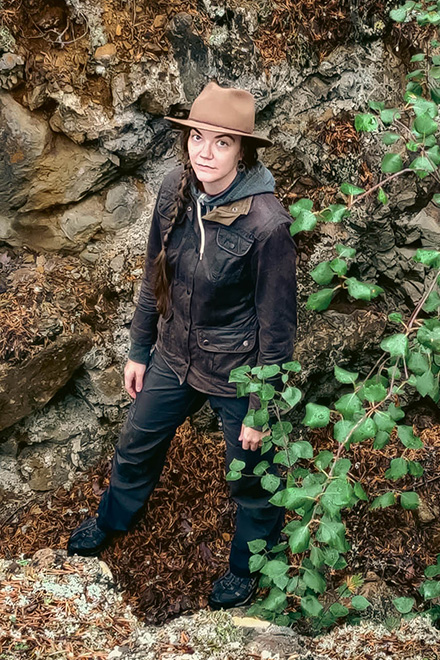
Research Team:  Arctic Anthropology

Florian Stammler

Research Professor

Arctic Centre

Florian has done research and lived in many regions of the Russian North since the mid 1990s, and has ever since enjoyed the particularities of how people contemporarily and historically organize their life in this vast area. Since the anthropology team’s big ORHELIA project, he has also started working comparatively with people living in the Western European Arctic, currently in South Greenland and Finnish Lapland. He has led several research projects working with Western and Russian Arctic societies and cultures. Much of his research and publications are on the encounter of (extractive) industries with animal-based livelihoods and how multiple land uses change the livelihoods of Arctic peoples, both indigenous and local. More recently, he has also worked on well-being, youth and Arctic urban anthropology. His research – often using a mix of participant observation and oral history as a method – contributes to broader theoretical debates on worldviews of extractivism, multi species ontologies and well-being.

Aytalina Ivanova

Postdoctoral Researcher

Arctic Centre

Aytalina Ivanova has a degree in legal history from Yakutia, East Siberia, where she has been an Associate Professor at the Faculty of Law of the North-Eastern Federal University since 2000. Since 2014 she specialises in Law and Anthropology, and is one of the few scholars who studies the “social life of law” in the Russian Arctic using the anthropological field method of participant observation. Over the past decade, Ivanova’s research has focused in particular on the legal aspects of the advancement of extractive industries into increasingly remote areas where industry typically encounters the traditional livelihoods of indigenous peoples, and on Arctic animal husbandry law. In addition to Yakutia, she has done fieldwork also in the Nenets Autonomous District, Kamchatka, and Lapland.

Nuccio Mazzullo

Senior Researcher

Nuccio got his PhD from the University of Manchester in Social Anthropology with a thesis on perception of landscape and concepts of space among Sami people in Northeastern Finland, where his regional specialization lies; in particular he has done fieldwork with Sámi reindeer herders in Sallivaara Reindeeer Association. The research focused on people’s relations with the landscape and on its influence in fashioning their sense of identity. More general issues of perception of the landscape, place and mobility play a prominent role in the research.

Anna Stammler-Gossmann

University Researcher

Arctic Centre

Anna has specialised in Arctic anthropology since 1995 and is a coordinator of the Arctic Studies Programme. Her research interests lie in polar communities’ studies, focusing on how communities across the Arctic and Sub-Antarctic (Patagonia) embed themselves within contexts of societal and environmental changes. Within this field, she investigates ways of ‘translating’ theoretical paradigms (sustainability, circularity, indigeneity) as applied in different economic sectors (waste utilisation, reindeer herding, fisheries, and tourism). In the anthropology of disaster (flooding, invasive species), her research examines the various frameworks at play in experiencing disastrous events and how ‘troubled’ property of a place is sensed through encounters between people and the environment. In her study on cold and permafrost, she analyses its multiple uses of cold as a physical conduit of economic realms and cultural states of being.

Karolina Sikora

Postdoctoral Researcher

Karolina did her PhD in legal anthropology at the University of Lapland, focusing on informal socio-legal systems and cultural heritage among the Izhma Komi of the Russian North. She has been based at the Arctic Centre since 2017, and previously held a postdoc position at Lund University. Currently, she works on the Kone Säätiö funded CULPRE project, examining how culturally diverse communities in Finnish Lapland and Finnmark practice everyday preparedness in sensitive Arctic borderlands. Karolina has lived and worked across Northwest Russia, Finnish and Swedish Lapland, focusing on law in practice, and the interplay of change and continuity in Arctic cultures and livelihoods.

NingNing Sun

Doctoral Researcher

Arctic Centre

NingNing is a doctoral researcher in the Arctic Anthropology Research Team. She is interested in the integration of innovation and technology with traditional livelihoods in Arctic reindeer herding societies, plural ontologies, multispecies relations, and Arctic adaptations in the context of climate change and competing land uses, while paying particular attention to community priorities, ethical co-creation, social-ecological resilience, as well as minority and decolonial perspectives. NingNing received her M.Phil. in Polar Studies from the Scott Polar Research Institute, University of Cambridge, and her B.A. in Environmental Studies and Economics from Dartmouth College, where she was a researcher at the Institute of Arctic Studies and conducted fieldwork in both Arctic Alaska and Fennoscandia.

Visiting Researchers

Ria-Maria Adams
Visiting Researcher

Arctic Centre

Ria-Maria defended her PhD thesis on youth wellbeing in northern Finland at the University of Vienna’s Department of Social and Cultural Anthropology. Her research interests focus on Arctic youth wellbeing, transport and tourism infrastructures, shrinking northern towns and sustainable communities. She is currently funded by the ERC Advanced Grant project InfraNorth, conducting research spanning from Finnish Lapland to communities along the ‘Iron Ore Line’ in northern Sweden, extending to the ice-free port of Narvik in Norway. Previously she worked on the WOLLIE project addressing Arctic youth wellbeing issues and in the LISH project focusing on local initiatives and liveability in shrinking towns.

Stephan Dudeck

Visiting Researcher

Stephan Johannes Dudeck is a social anthropologist and Research Fellow at the Laboratory of Arctic Studies, Institute for Cultural Research, University of Tartu, affiliated with the University of Lapland and the Foundation for Siberian Cultures. Since the early 1990s, he has conducted collaborative fieldwork with Khanty, Nenets, and other Indigenous communities in Western Siberia, focusing on Indigenous knowledge, human–environment relations, extractivism, and social change in the Arctic. His work combines anthropology with audiovisual and artistic collaboration. He currently participates in the Horizon Europe BIRGEJUPMI Project on sustainable Arctic coastal futures.

Panu Itkonen

Visiting Researcher

Panu Itkonen, visiting senior researcher, got his PhD from the University of Helsinki in social and cultural anthropology with a thesis on cooperation and reciprocity in the Skolt Sami reindeer herding community in Northern Finland and the community’s relation to state administration. At the Arctic Centre University of Lapland, Panu has done research among the Skolt Sami, other local people, and representatives of administration. His research interests are directed to productive processes in the north and human relations, including relations to the environment. Recently, he has focused on sustainability issues. In addition to research-related activities, he has lectured and participated in student guidance at the University of Lapland.

Francis Joy

Postdoctoral Researcher

Arctic Centre

Francis Joy is a visiting post-doctoral researcher from the United Kingdom, currently working as a member of the Arctic Anthropology Research Team at the University of Lapland Arctic Centre. The focus for research is an ongoing study of Sámi religion, history, culture, and traditions, which includes a study of sacred sites, prehistoric rock paintings in Finland and what appear as links between cosmological landscapes on sacred Sámi drums from the seventeenth century. Francis has also published five books of poetry and worked as a coordinator for the Gifts from the Sentient Forest research project funded by Kone Säätiö between 2024-2026.

Teresa Komu

Visiting Researcher

Teresa received her PhD in cultural anthropology from the University of Oulu in 2020. Her doctoral research examined the long-term coexistence of reindeer husbandry, mining and nature-based tourism in northern Fennoscandia. Her research focuses on life in northern Finland, with a particular interest to northern human-environment relations and on the anthropology of the good life. She has studied topics ranging from environmental change and reindeer herding to local responses to mining, youth mobility and wellbeing, and the cultural meanings attached to mining. She is currently conducting postdoctoral research on the religious dimensions of human-underground relations in twentieth-century Finnish underground mining.

Roza Laptander

Visiting Researcher

Roza Laptander is a linguistic anthropologist. Her research interests are based on sociolinguistics, linguistic anthropology, documentation the Nenets language and spoken history of the Western Siberian Nenets. In her work she describes the Nenets memories about the past and their present life in the Yamal tundra. She is also describing Nenets’ culture, language and customs in the tundra of northwest Siberia from an inside perspective. Roza defended her PhD “When we got reindeer, we moved to live to the tundra: The Spoken and Silenced History of the Yamal Nenets” at the University of Lapland (2020). Through analyzing silence in the example of the Yamal Nenets people stories, Laptander studied the role of silence and silencing offering a new approach to understanding how small indigenous societies keep memories and stories about their past.

Last updated: 8.5.2026